





 Ultra-Low Loss TNC Male to SMA...
Price range: 794 EGP through 30.195 EGP
Ultra-Low Loss TNC Male to SMA Male LMR400 50 Ohm Extension Cable
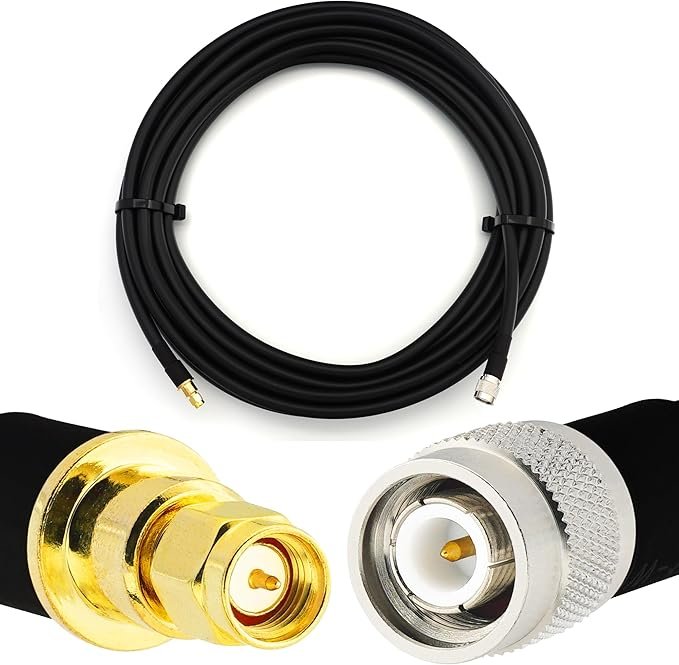
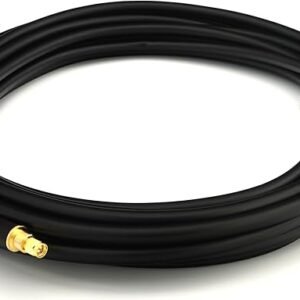
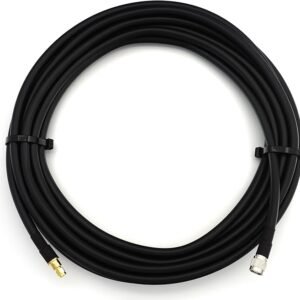
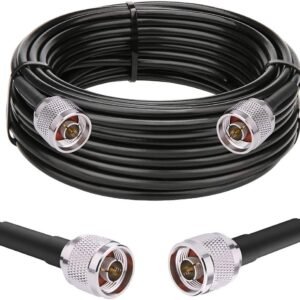
Bridging heavy-duty industrial radio gear directly to indoor transceivers or cellular gateways without introducing high insertion loss requires an engineered, low-attenuation transmission line. The premium TNC Male to SMA Male LMR400 50 Ohm coaxial extension cable from OHM Cables provides a heavy-duty interconnect built specifically to connect high-precision GNSS/GPS survey equipment, tactical radio transceivers, cellular boosters, Helium gateways, and RF laboratory setups. Featuring a threaded, vibration-proof TNC Male plug on one end and a sub-miniature SMA Male plug on the other, this assembly links distinct hardware interfaces cleanly without needing lossy adapter barrels.
High-frequency wireless signals—such as GPS L1/L2 (1.2–1.5 GHz), Mid-Band 5G (Sub-6 GHz), CBRS, or 2.4 GHz Wi-Fi—suffer severe attenuation when routed through thin, light-gauge jumper cords like RG58 or RG174. Thin lines convert valuable RF energy into thermal loss, leading to sluggish throughput, increased packet errors, and reduced signal coverage. Upgrading your RF architecture with a heavy-duty TNC Male to SMA Male LMR400 equivalent extension cable bypasses these physical bottlenecks. Designed with a thick 10.3 mm profile, a solid copper-clad core, and an advanced double-shield matrix, this assembly guarantees maximum signal amplitude down to your device port.

Professional RF System Engineering Insight: Directly adapting a heavy 400-series cable line between two different connector formats (a heavy-duty TNC interface and a sub-miniature SMA terminal) requires precise crimp and solder calibration to avoid localized impedance spikes. Our TNC Male to SMA Male LMR400 assemblies are precision-terminated to maintain a strict $50 \Omega$ line profile. This mechanical consistency keeps your Voltage Standing Wave Ratio (VSWR) exceptionally low ($\le 1.25$ across main wireless bands), preventing energy reflections that degrade high-order QAM data modulations.
Core Engineering Advantages for High-Frequency Wireless Systems
Selecting the proper cable architecture is essential for maintaining signal integrity across long antenna drops. The OHM Cables TNC Male to SMA Male LMR400 high-performance extension provides distinct technical advantages over standard braided jumpers:
1. Ultra-Low Attenuation Across Microwave Bands
Boasting an industrial 10.3 mm (0.405-inch) physical form factor, the 400-series architecture drastically reduces skin-effect resistive losses. This thick conductor design ensures clean, high-amplitude signal transmission across 700 MHz, 1.5 GHz, 2.5 GHz, and 3.5 GHz bands, making it the ideal choice for long down-leads from outdoor radio masts to indoor equipment cabinets.
2. Dual-Layer Shield Grid for 90 dB RF Isolation
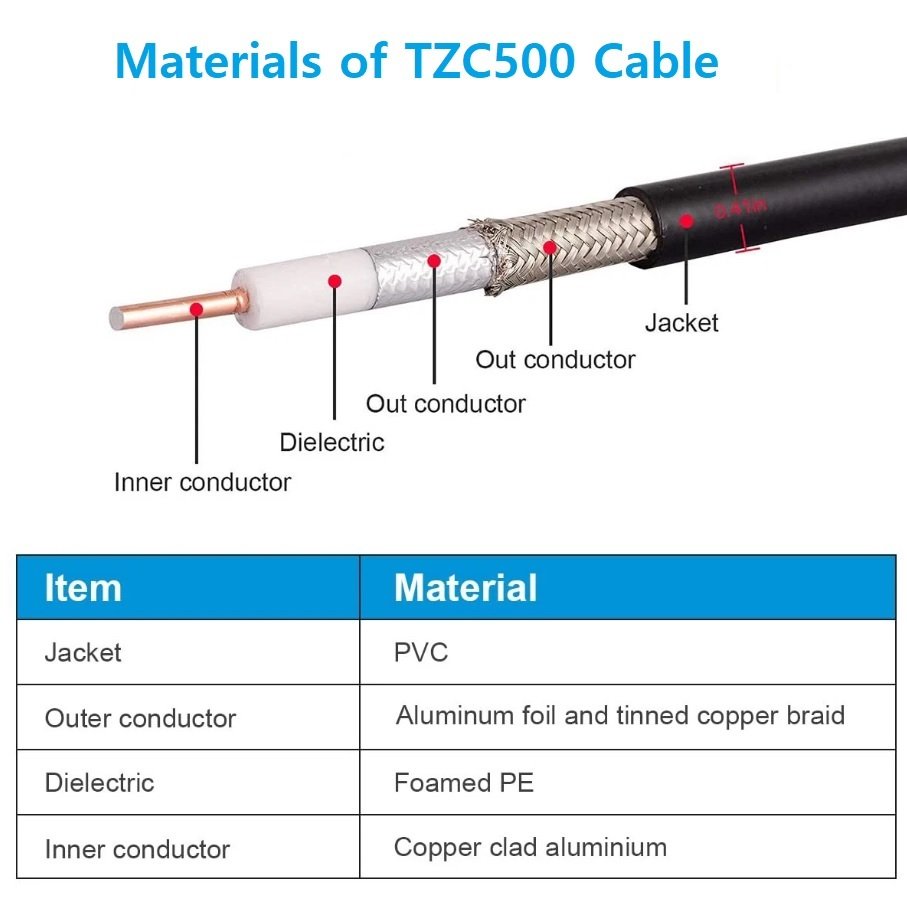
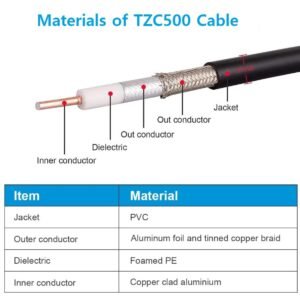
Operating near noisy industrial machinery, high-density cellular towers, or multi-transmitter radio racks requires robust shielding. This TNC Male to SMA Male LMR400 lead utilizes a dual-shield matrix: an inner layer of 100% coverage bonded aluminum foil blocks high-frequency electromagnetic interference (EMI), while a dense outer tinned copper braid provides exceptional low-frequency grounding and physical shielding, yielding an RF isolation rating greater than 90 dB.
3. Ruggedized Weatherproof Terminations
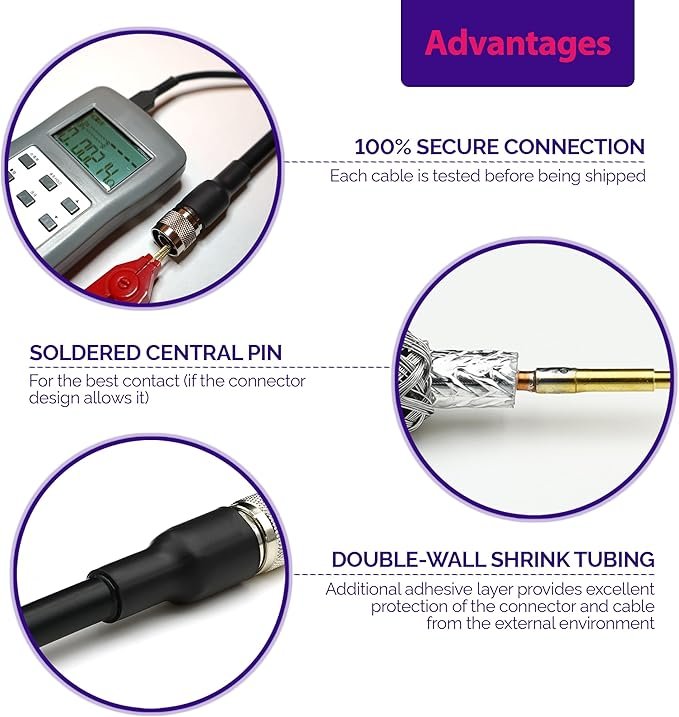
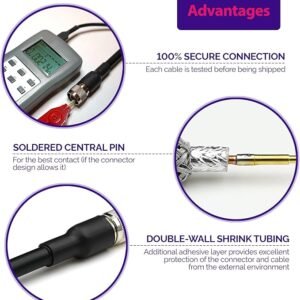
Outdoor mast and mobile installations face constant thermal cycling, direct solar radiation, and moisture. Our assemblies feature solid brass connectors precision-machined and finished in durable nickel and gold plating. The TNC Male coupling nut includes an internal silicone O-ring to prevent moisture ingress, while dual-wall adhesive-lined heat shrink tubing covers both connector junctions for strain relief and weather sealing.

Advanced Materials & Long-Term Calibration Stability
Every element of the TNC Male to SMA Male LMR400 assembly is selected to guarantee steady electrical performance over years of continuous outdoor or mobile service. The outer protective sheath is constructed from a rugged, UV-stabilized Polyethylene (PE) compound, engineered to withstand intense solar radiation, freezing sub-zero climates, and heavy physical stress without cracking or taking on moisture.
Internally, signals travel along a high-conductivity solid copper-clad aluminum center conductor insulated by a micro-cellular, gas-injected closed-cell foam polyethylene (FPE) dielectric. This advanced insulation profile yields a high velocity of propagation (85%), ensuring fast, phase-stable signal transmission while lowering internal capacitive loss.
Common Field Applications and Deployments
- GNSS & Precision GPS Surveying: Linking outdoor TNC-equipped reference antennas directly to indoor receiver modules or logging hardware featuring SMA inputs.
- 5G & 4G LTE Gateways: Interfacing outdoor commercial antennas or radio equipment with internal cellular routers equipped with SMA ports.
- Tactical & Commercial Two-Way Radio: Serving as a low-loss jumper to bridge UHF/VHF mobile transceivers to high-gain external antennas.
- Telemetry & Mobile Command Units: Providing a vibration-resistant, low-loss interconnect for vehicular, marine, and field testing systems.
Technical Specifications & Performance Metrics
| Technical Parameter / Metric | Engineering Value & Cable Material Standards |
|---|---|
| **Product Component Identification** | Premium **TNC Male to SMA Male LMR400** Coaxial Extension |
| **Cable Type Equivalency** | LMR-400 / Low-Loss 400 Series / 50-Ohm Low Attenuation standard |
| **Connector Configurations** | TNC Male (Internal Thread / Male Pin) to SMA Male (Internal Thread / Male Pin) |
| **Connector Housing Metallurgy** | Solid Heavy-Duty Brass with Corrosion-Resistant Nickel / Gold Plating |
| **Center Contact Pin Composition** | High-Purity Hard Brass with Premium Gold Plating |
| **Nominal Line Impedance** | $50 \Omega$ Calibrated RF Standard |
| **Velocity of Propagation (VoP)** | 85% Nominal |
| **Shielding Effectiveness Rating** | $> 90 \text{ dB}$ (Dual Shield: Bonded Aluminum Foil + Tinned Copper Braid) |
| **Usable Frequency Bandwidth** | DC up to 6.0 GHz High-Frequency Performance Range |
| **Voltage Standing Wave Ratio (VSWR)** | $\le 1.25:1$ Typical | $\le 1.35:1$ Maximum Across 0-4 GHz Spectrum |
Attenuation Profile (Loss per 10 meters / 32.8 feet)
- 700 MHz (Low-Band 5G / LTE): ~1.1 dB attenuation loss
- 900 MHz (Industrial Radio / ISM / Helium): ~1.3 dB attenuation loss
- 1575.42 MHz (GPS L1 Band): ~1.8 dB attenuation loss
- 1800/2100 MHz (Core 4G LTE Bands): ~2.0 dB attenuation loss
- 2400 MHz (Wi-Fi / ISM Band): ~2.4 dB attenuation loss
- 3500 MHz (5G C-Band / CBRS): ~2.9 dB attenuation loss
- 5800 MHz (High-Band Wi-Fi): ~3.9 dB attenuation loss
Why Choose OHM Cables Assemblies
At OHM Cables, we understand that a high-frequency communications system is only as reliable as its weakest connection point. We reject loose clearances, cheap flash platings, and low-grade steel braids that oxidize under outdoor exposure. Every TNC Male to SMA Male LMR400 extension lead is built using specialized pneumatic tooling, precision hex-crimped, and sealed with dual-wall adhesive heat shrink tubing. Our strict quality guidelines ensure every assembly is fully tested on vector network analyzers (VNAs) to verify perfect VSWR and low insertion loss before shipment.
Frequently Asked Technical Questions (FAQ)
What is the minimum bend radius of this LMR400 extension cable?
For safe field deployment, the minimum bend radius of this LMR400 equivalent cable is 25.4 mm (1.0 inch) for a single fixed bend, and 101.6 mm (4.0 inches) for repeated handling loops. Bending the cable beyond these thresholds can warp the micro-cellular foam dielectric, alter the $50 \Omega$ line profile, and trigger immediate signal reflections.
Will this assembly work with RP (Reverse Polarity) hardware?
No. This cable uses standard TNC Male and standard SMA Male hardware (both feature internal threads with protruding center pins), which is standard for commercial radios, GPS systems, and cellular infrastructure. Some Wi-Fi hardware uses RP-TNC or RP-SMA interfaces. Be sure to check your hardware ports before placing your order.
Why use a TNC connector instead of a BNC connector?
While both connector types share similar inner pin dimensions, TNC connectors feature fine screw threads instead of BNC’s bayonet twist lock. The threaded coupling of the TNC Male interface prevents signal chatter and intermittent losses caused by mechanical shock and vibration, allowing it to perform reliably up to 6 GHz.
Final Verdict for Telecommunications Engineers & Network Builders
Do not let high insertion losses or cheap adapter barrels bottleneck your high-frequency radio links and GPS arrays. The OHM Cables premium TNC Male to SMA Male LMR400 low-loss extension cable provides the rugged physical durability, 90 dB isolation shielding, and steady 50 Ohm matching required to maximize your wireless performance. To complete your system setup, explore our full selection of premium RF Connectors and rugged Coaxial Cable Assemblies. You can also review high-frequency standards directly through the IEEE Official Resource Center. Upgrade your installation gear with this professional LMR400 extension today, and secure the clean, long-range signal paths your equipment was built to deliver.
Related products




You may add any content here from XStore Control Panel->Sales booster->Request a quote->Ask a question notification
At sem a enim eu vulputate nullam convallis Iaculis vitae odio faucibus adipiscing urna.
Reviews
There are no reviews yet.