





 Enterprise LTE 4G Cisco Antenn...
500 EGP
Enterprise LTE 4G Cisco Antenna – High-Performance TNC Male Omnidirectional Terminal
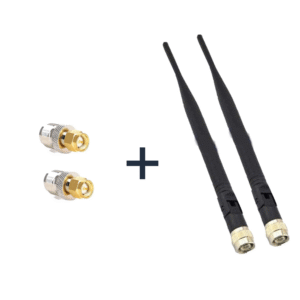
In enterprise networking, remote branch deployments, and industrial Internet of Things (IIoT) frameworks, infrastructure reliability dictates overall operational efficiency. The premium-grade LTE 4G Cisco Antenna from OHM Cables is an expertly engineered RF terminal designed specifically to match the demanding physical and electrical criteria of Cisco modular routers, integrated services gateways, and edge compute platforms. Delivering a stable wireless link across multiple cellular spectrums, this critical component acts as the baseline transceiver interface for systems running mission-critical machine-to-machine (M2M) telemetry, primary corporate failover circuits, and remote SCADA infrastructure. Featuring a calibrated $50 \Omega$ match, it enables enterprise hardware to achieve maximum signal throughput without data packet drops or unintended carrier drops.
Using generic, uncertified cellular accessories on high-end enterprise equipment often creates significant performance bottlenecks. When a high-capacity edge gateway or cellular interface card is deployed within metal server cabinets, thick physical concrete utility rooms, or dense branch offices, local signal attenuation increases dramatically. These barriers can force high-end routing engines into sluggish fallback states, resulting in increased packet retransmissions and high latency. Upgrading your deployment with our dedicated LTE 4G Cisco Antenna introduces a professional omnidirectional solution featuring an optimized wideband radiator core. This ensures consistent cellular coverage and fast data speeds across both urban settings and remote field locations.

Professional RF Engineering Insight: High-availability networking demands interfaces designed to handle continuous physical stress and thermal variation. The integration of a Threaded Neill–Concelman (TNC) male connector standard provides a significantly more robust mechanical lock compared to smaller SMA alternatives, ensuring exceptional shielding efficiency and minimal insertion loss across wide operating frequencies.
The Critical Functional Roles of the LTE 4G Cisco Antenna in Enterprise Architecture
An industrial-grade wireless node depends on components designed to handle multiple electrical and mechanical tasks simultaneously. The OHM Cables LTE 4G Cisco Antenna satisfies these needs by fulfilling three distinct architectural roles within your network infrastructure:
1. The Edge Gateway Enabler: Minimizing Intermodulation & Return Loss
When high-speed enterprise modules transmit massive data packages, any impedance mismatch within the terminal path causes radio energy to bounce backward down the line. This return loss creates dangerous thermal strain on delicate RF front-end chips and drops your real-world signal-to-noise ratio (SNR). The primary role of our LTE 4G Cisco Antenna is to serve as an ultra-precise electrical match. By locking the Voltage Standing Wave Ratio (VSWR) to a low profile ($\le 1.5$), it optimizes forward power transfer, protecting expensive Cisco interface cards from long-term component degradation and ensuring high-quality, reliable data paths.
2. The Multi-Band Resilience Anchor: True 360-Degree Coverage Spread
Modern corporate networks utilize multi-carrier fallback strategies to maintain continuous uptime. This means edge routers must be able to switch between different carrier bands if a primary tower becomes congested or goes offline for maintenance. The LTE 4G Cisco Antenna functions as a flexible, multi-band resilience anchor. Engineered with a balanced $360^\circ$ horizontal omnidirectional radiation pattern, it captures waves from multiple surrounding cell sites simultaneously, eliminating the need for manual directional aiming and ensuring smooth carrier handoffs.
3. The Industrial IoT Shield: Suppressing High-Frequency Ambient Interference
Industrial server rooms and automated utility spaces are filled with electromagnetic interference (EMI) from heavy machinery, high-voltage lines, and nearby consumer devices. This ambient noise can easily corrupt data streams on low-quality antennas. The LTE 4G Cisco Antenna acts as an effective signal shield. Its heavy-duty internal architecture filters out out-of-band noise, allowing connected Cisco modules to comfortably maintain advanced modulation schemes like 64-QAM or 256-QAM for fast, error-free wireless data throughput.

Mechanical Construction and Premium Materials: Engineered for Long-Term Fleet Use
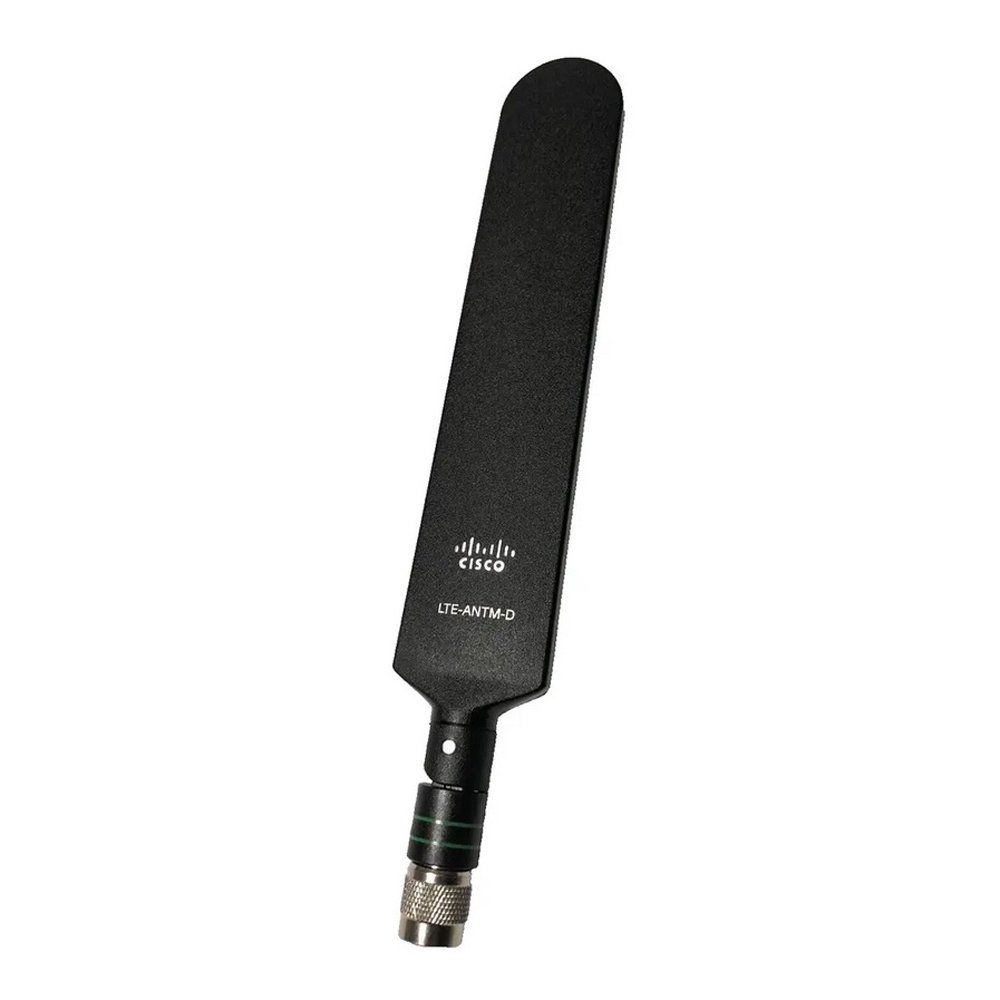
A deep mechanical teardown of this enterprise LTE 4G Cisco Antenna highlights why it outlasts standard consumer components. The internal radiator core features a precision-stacked copper dipole array. Copper provides excellent electrical conductivity, allowing weak high-frequency wireless waves to pass across the conductive surfaces with minimal resistive heating or signal degradation. Each internal element is mathematically tuned to align with worldwide 4G LTE frequencies ($698\text{ MHz}$ to $960\text{ MHz}$ and $1710\text{ MHz} – 2700\text{ MHz}$), giving your network deployment true multi-band versatility.
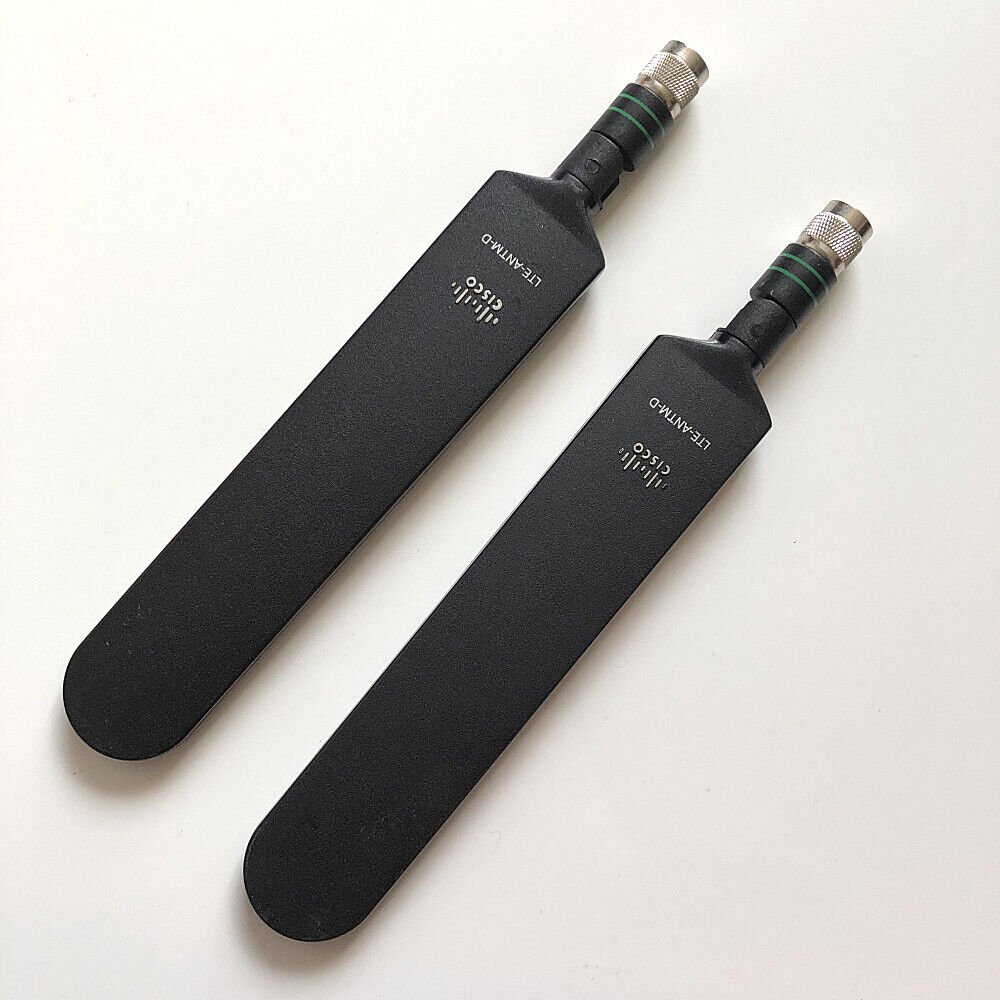
To shield this precise copper core from harsh environmental conditions, the antenna is encased in a thick, high-density thermoplastic elastomer (TPE) rubber sleeve. This outer jacket protects the internal elements from physical impacts, vibrations, and accidental bending, all while remaining completely transparent to radio frequencies (RF). This transparency means the outer shell introduces near-zero dielectric loss, allowing radio waves to pass through unhindered. The base of the antenna features an adjustable 90-degree articulation hinge and a 360-degree rotational locking ring, allowing installers to position the antenna cleanly around crowded patch panels, wall mounts, or narrow server racks.
Precision TNC Coupling and Industrial-Grade Interface Engineering
At the base of each LTE 4G Cisco Antenna unit is a standard, precision-threaded TNC Male connector (threaded interior with a central male mating pin). Unlike standard WiFi RP-SMA ports or consumer SMA setups, the TNC standard utilizes a larger, more robust threaded union body. The internal center contact pin is heavily plated with high-purity gold to protect against oxidation and galvanic corrosion, keeping the data contact points perfectly conductive even when deployed in high-humidity indoor environments or humid coastal zones.
Strategic Deployments Across Enterprise & Commercial Networks
Thanks to its industrial durability, wide frequency tuning, and reliable TNC mating design, the LTE 4G Cisco Antenna is highly specified by network engineers across several key sectors:
- Enterprise SD-WAN Failover: Providing reliable secondary cellular links for corporate branch offices, banking centers, and retail stores, ensuring zero business disruption if a primary fiber line is severed.
- Remote Industrial Gateways: Powering ruggedized Cisco IoT gateways installed in remote oil fields, mining sites, and utility substations for continuous SCADA data telemetry.
- Public Safety & First Responder Vehicles: Delivering high-vibration resistant antennas for mobile access routers mounted inside police cars, fire engines, and mobile command units.
- Atmospheric Monitoring Stations: Connecting widespread environmental sensors, remote weather stations, and seismic monitors back to central databases over long distances.
- Smart Supply Chain Infrastructure: Supporting real-time tracking, inventory syncing, and automated asset management within large fulfillment centers and shipping hubs.
Managing Signal Attenuation Across Enterprise Coaxial Lines
A fundamental law of radio frequency physics states that signal attenuation increases as operating frequencies rise and as transmission cables grow longer. To get the most out of your high-gain LTE 4G Cisco Antenna, you must carefully select the right extension cables and adapters for your installation. Using cheap, unshielded wires over long distances will quickly erase the decibel gains achieved by the antenna, turning a clean cellular signal into weak background noise. For cable runs extending past a few feet, we highly recommend using thick, double-shielded, low-loss cables like LMR400 to preserve your signal strength.
Proper cable routing also means avoiding sharp, tight bends. Bending a high-frequency coaxial cable at a sharp 90-degree angle crushes its internal dielectric layer and disrupts its uniform $50 \Omega$ impedance, creating a significant signal reflection point that degrades data speeds and increases network latency (Ping). Keeping your cable runs as straight as possible and using premium materials ensures that every decibel of signal captured by the outdoor antenna arrives intact at your router, delivering the fast upload and download speeds your operations depend on.
| Technical Parameter | Engineering Specification Value & Infrastructure Alignment |
|---|---|
| Product Classification Standard | LTE 4G Cisco Antenna (Industrial Omnidirectional Articulated Terminal) |
| Supported Frequency Bands | 698 MHz – 960 MHz & 1710 MHz – 2700 MHz (Global 4G LTE & 3G Legacy) |
| Nominal System Impedance | $50 \Omega$ Calibrated (Matches Native Cisco Router Mainboard Specs) |
| Voltage Standing Wave Ratio (VSWR) | $\le 1.5:1$ Average Profile Across Targeted Frequencies (Low Return Loss) |
| Connector Interface Standard | TNC Male (Threaded Mechanical Body with Internal Center Pin) |
| Radiation Pattern Configuration | 360° Horizontal Omnidirectional Toroidal Wave Spread |
| Articulating Swivel Window | 90° Fold Joint and 360° Rotating Base Nut Lock |
| Sleeve Enclosure Material | High-Density UV-Stabilized TPE Heavy-Duty Rubber Jacket |
| Operational Temperature Window | -40°C to +85°C Sustainable Window (Extremes of Desert and Artic) |
| Ground Plane Requirement | Independent Design (Full Performance on Plastic or Metal Enclosures) |
Field Installation Best Practices for Network Engineers
- Ensure Firm Threaded Engagement: Thread the TNC Male nut onto your Cisco router bulkhead port by hand until it fits snugly. Avoid using heavy metal wrenches, which can strip the precision threads or snap the internal gold-plated contact pins.
- Orient for Vertical Polarization: For optimal signal exchange with regional towers, position both antennas from your router’s MIMO array completely vertical. If space is tight, angling them slightly apart at 45 degrees can enhance spatial diversity.
- Position Clear of Heavy Obstructions: Place your router or modem away from thick metal filing cabinets, server rack doors, and concrete pillars to maximize the omnidirectional reach of the LTE 4G Cisco Antenna.
- Isolate from High-Power EMI Sources: Maintain at least one meter of physical clearance between your antenna and power transformers, industrial motors, or high-power WiFi access points to prevent local receiver desensitization.
Why Partner with OHM Cables for Your Enterprise Infrastructure
At OHM Cables, we understand that small network components play a massive role in maintaining enterprise productivity and system uptime. That is why we enforce strict quality control standards, completely avoiding the sub-standard materials and loose manufacturing tolerances common in cheap consumer alternatives. Every single LTE 4G Cisco Antenna that leaves our facility undergoes rigorous testing with advanced vector network analyzers to verify perfect impedance matching, stable VSWR performance, and structural integrity. We rely on premium metals and rugged outer jackets to ensure our products deliver long-term, dependable service under real-world conditions for network professionals and system integrators alike.
Investing in a high-quality LTE 4G Cisco Antenna pack is a smart way to safeguard your overall hardware investment. By eliminating frequent connection drops, resolving unexplained latency spikes, and protecting your expensive modems against impedance imbalances, our products offer reliable peace of mind. Whether you are setting up a secure cellular failover line for a business storefront, connecting remote telemetry modules across a municipal utility grid, or building out a large-scale smart IoT network, this antenna bundle provides the high-fidelity performance your operations demand.
Frequently Asked Technical Questions (FAQ)
Can this LTE 4G Cisco Antenna support newer 5G network bands?
Yes, this antenna is fully compatible with low-band and mid-band Sub-6 GHz 5G networks that fall within its $698\text{ MHz}$ to $2700\text{ MHz}$ operating range. However, for specialized high-band millimeter-wave 5G networks, we recommend checking out our dedicated 5G high-frequency antenna lines.
What is the physical difference between a TNC connector and an RP-TNC connector?
A standard TNC Male connector features internal threads and a central protruding metal pin, designed for cellular modems and routers. An RP-TNC (Reverse Polarity) connector reverses this pin layout and is typically used for enterprise WiFi equipment. This LTE 4G Cisco Antenna uses a standard TNC Male connector, making it perfect for cellular hardware lines.
Can this articulating rubber duck antenna be permanently mounted outdoors?
While the TPE outer jacket is highly UV-resistant and can handle wide temperature shifts well, these specific models are optimized for indoor or weather-protected enclosures. For permanent, unprotected outdoor installation, we recommend checking out our dedicated waterproof dome or marine antenna lines.
Does this antenna require an external grounding plane to achieve its full rated gain?
No, this premium LTE 4G Cisco Antenna features an internal electrical design that operates independently of a ground plane. It delivers its full rated gain and uniform coverage pattern without needing to be mounted on a large metal surface, giving you complete installation flexibility.
Final Verdict for Infrastructure Systems Engineers
Do not let a low-quality stock antenna bottleneck your enterprise wireless infrastructure. The OHM Cables LTE 4G Cisco Antenna array delivers the structural durability, reliable $50 \Omega$ impedance consistency, and dependable omnidirectional coverage required to keep your data flowing smoothly in today’s connected environments. To complete your network configuration, explore our full catalog of premium Coaxial Cable Assemblies and heavy-duty RF Connectors. You can also review international telecommunication design standards by visiting the IEEE Official Resource Center to learn more about optimizing high-frequency RF layouts. Upgrade your network infrastructure with this reliable omnidirectional link today, and experience the true peak performance and rock-solid connection stability your system was built to deliver.
Related products




You may add any content here from XStore Control Panel->Sales booster->Request a quote->Ask a question notification
At sem a enim eu vulputate nullam convallis Iaculis vitae odio faucibus adipiscing urna.
Reviews
There are no reviews yet.